Digital Marketing
12 May 2026
SEO Still Matters More Than Ever In The AI Era
If you’ve spent more than five minutes online recently, you’ve probably seen someone claim that “SEO is dead.” Usually, it comes after a Google update, an AI breakthrough, or a dip in website traffic. But here’s the reality: - SEO is not dead. Bad SEO is dead. - The businesses still winning online in 2026 are the ones that understand a simple truth: Search has evolved from keyword stuffing and backlink tricks into authority, trust, user experience, and AI visibility. And now, with Google AI Overviews and GEO (Generative Engine Optimization), the game is changing again. The good news? Most companies are still behind - Which means businesses that adapt now have a massive opportunity to dominate search results before their competitors catch up.
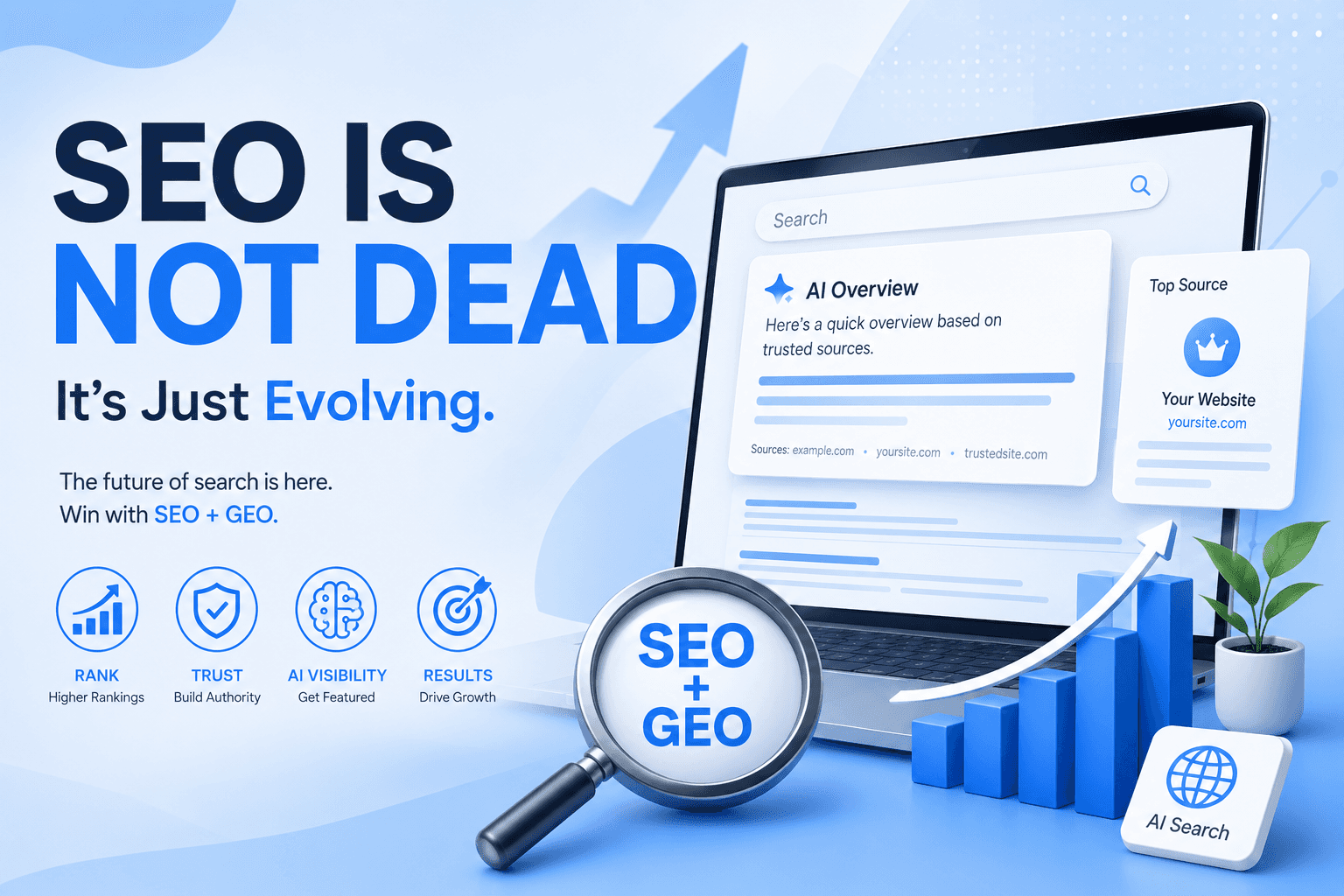
What People Mean When They Say “SEO Is Dead”
SEO has been declared dead for over 15 years.
When mobile search arrived.
When voice search launched.
When Google released featured snippets.
When TikTok became a search engine.
And now with AI-generated answers.
Every time technology changes, people assume SEO disappears.
But search behavior never disappears.
People will always search for:
Solutions
Services
Products
Information
Comparisons
Local businesses
Expert advice
The only thing changing is how search engines deliver answers.
That means SEO is not dying.
It’s evolving.
Traditional SEO Still Works — If You Do It Properly
Google still relies heavily on:
High-quality content
Website authority
Backlinks
User engagement
Technical optimization
Search intent
Site speed
Topical relevance
Businesses ranking on page one today are still investing heavily in SEO because it continues to produce one of the highest ROI marketing channels available.
Unlike paid ads, SEO compounds over time.
A strong article written today can generate leads for years.
That’s why companies investing in SEO strategically are still outperforming businesses relying entirely on social media or paid advertising.
The Real Shift: Search Engines Are Becoming Answer Engines
This is where things get interesting.
Google is no longer just showing links.
It’s increasingly generating answers directly inside search results using AI Overviews.
Users can now get summaries, recommendations, comparisons, and explanations without clicking multiple websites.
This has created panic across the marketing industry.
But smart businesses see the opportunity.
Because Google’s AI still needs sources.
And the websites Google trusts become the sources powering AI-generated answers.
That’s where GEO comes in.
What Is GEO (Generative Engine Optimization)?
GEO stands for Generative Engine Optimization.
It’s the evolution of SEO for AI-driven search experiences.
Instead of optimizing only for rankings, GEO focuses on optimizing content so AI systems can:
Understand it
Trust it
Reference it
Cite it
Summarize it
Feature it inside AI-generated answers
This applies to:
Google AI Overviews
ChatGPT search experiences
Bing Copilot
Perplexity
Gemini
AI assistants
Voice AI platforms
In simple terms:
Traditional SEO helps you rank.
GEO helps you become the answer.
Why GEO Matters More Than Ever
AI-generated search results are changing user behavior rapidly.
Instead of clicking ten blue links, users increasingly want:
Instant answers
Trusted summaries
Clear recommendations
Expert insights
That means search engines are prioritizing content that demonstrates:
Real expertise
Clear structure
Strong authority
Trustworthiness
Original insights
Accurate information
Thin AI-generated spam content is becoming easier for search engines to ignore.
Meanwhile, businesses producing genuinely useful content are gaining even more visibility.
How Businesses Can Win with SEO + GEO
The future isn’t choosing between SEO or AI optimization.
The future is combining both.
Here’s what modern businesses should focus on:
Create Expert-Led Content
Google and AI systems increasingly reward content that demonstrates real expertise.
That means:
Industry knowledge
First-hand experience
Original insights
Real examples
Useful depth
Generic AI-written content alone is no longer enough.
Focus on Search Intent
The best SEO strategy today is understanding why someone searches.
Are they trying to:
Buy?
Learn?
Compare?
Solve a problem?
Find a local provider?
Content aligned with intent consistently performs better in both traditional rankings and AI-generated summaries.
Build Topical Authority
Publishing random blog posts no longer works well.
Modern SEO rewards websites that deeply cover a subject area.
For example, a digital marketing agency should create interconnected content around:
SEO
GEO
AI search
Local SEO
Technical SEO
Content marketing
Conversion optimization
This helps search engines view your brand as a trusted authority.
Optimize for AI Readability
AI systems love structured content.
That means using:
Clear headings
Concise explanations
FAQ sections
Bullet points
Definitions
Statistics
Easy-to-scan formatting
Well-structured content increases the likelihood of being featured in AI Overviews.
Build Brand Authority Beyond Google
Mentions across the web matter more than ever.
AI systems analyze broader signals including:
Reviews
Citations
PR mentions
Social proof
Industry references
Brand searches
Strong brands win in AI-driven search environments.
The Biggest SEO Mistake Businesses Make in 2026
Most businesses still treat SEO like a one-time task.
They publish a few blogs, add some keywords, and expect instant results.
That approach no longer works.
Modern SEO is an ongoing authority-building strategy.
The companies dominating search today are consistently:
Publishing valuable content
Updating old pages
Improving user experience
Building trust
Earning backlinks
Expanding topical relevance
Adapting to AI-driven search
SEO is no longer about gaming algorithms.
It’s about becoming the best answer online.
Will AI Replace Websites Completely?
No.
AI still needs trusted sources.
Without websites creating original content, AI systems would have nothing reliable to reference.
In fact, websites with strong authority may become more valuable because AI platforms prefer trusted sources over low-quality content farms.
The internet is moving toward:
Fewer low-quality sites
More authoritative brands
Higher trust standards
Better user experiences
That’s good news for businesses willing to invest properly in content and SEO.
Final Thoughts: SEO Is Far From Dead
SEO in 2026 looks different from SEO in 2016.
But the core principle remains exactly the same:
Businesses that provide the best answers earn visibility.
The difference now is that visibility happens across:
Google rankings
AI Overviews
AI assistants
Voice search
Generative search engines
Conversational AI platforms
The winners won’t be the businesses trying to manipulate algorithms.
The winners will be the brands building genuine authority, trust, and useful content.
SEO is not dead.
It’s entering its most important era yet.
And businesses adapting to GEO and AI-driven search today will have a major advantage tomorrow.